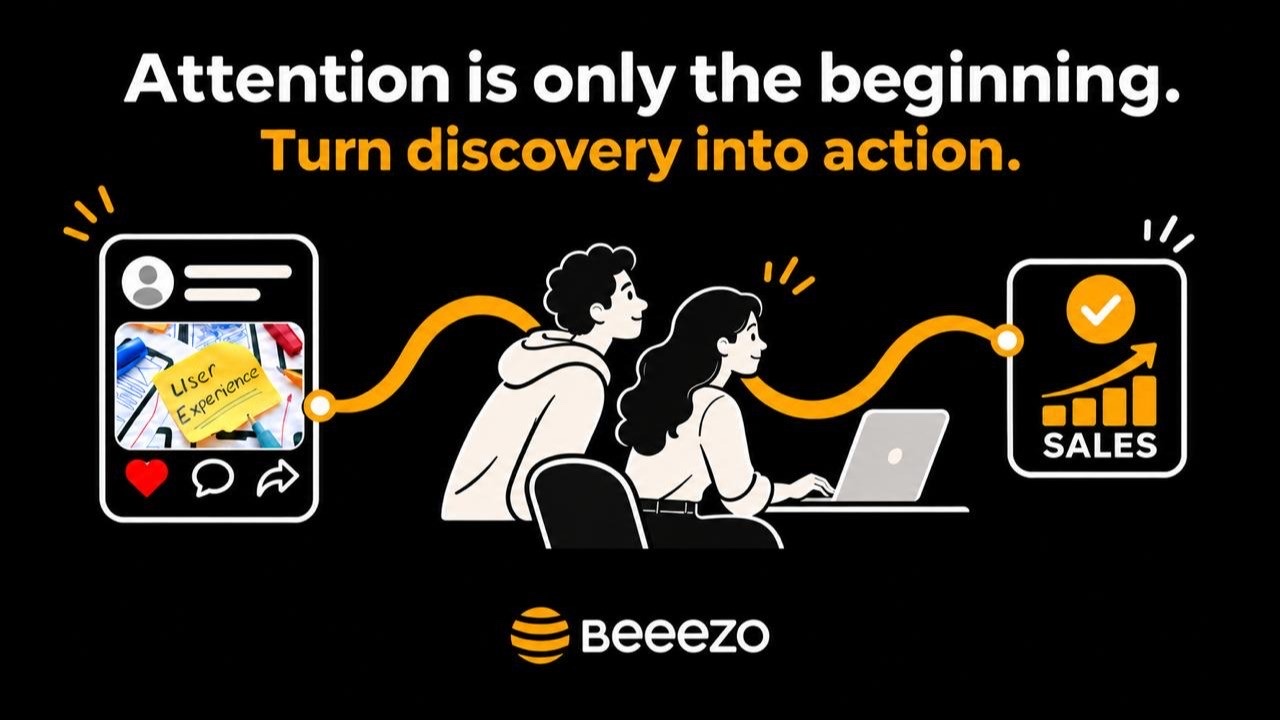
You can build an excellent product, create a beautiful website, publish useful content, and still struggle with one fundamental business challenge.
Getting people to discover what you've built.
For businesses of all sizes, this is an increasingly important part of the growth equation. Creating something valuable and making that value visible are two very different jobs.
Your website explains what you offer. Your social pages introduce your company. Your content demonstrates what makes your product useful. But none of these investments can deliver their full potential if the people you want to reach never encounter them.
That raises an important question: are you investing enough in helping people discover your business, or are you mostly investing in creating things you hope they will find?

Your social presence is part of how people evaluate your business
Imagine someone hears about your company through a recommendation, sees your name in a discussion, or encounters your product for the first time.
What do they do next?
They may search for your company, visit your website, or open your social profile to understand who you are.
Can they quickly figure out what you offer? See your product in action? Find answers to practical questions? Understand what makes your business different?
Your social presence can answer these questions before a conversation even begins. And research supports its importance.
According to the 2024 Edelman x LinkedIn B2B Thought Leadership Impact Report, 73% of surveyed B2B buyers consider thought leadership a more trustworthy basis for evaluating a company's capabilities than traditional marketing materials. The same research found that 54% had been prompted to research a company's products or services after encountering its thought leadership.
The message is important: people don't necessarily wait for a sales conversation to form an opinion about your business. They discover, research, compare, and develop their own understanding.
A product demonstration can make an unfamiliar solution easier to understand. An educational post can help someone recognize a problem your product solves. A thoughtful response to a question can demonstrate your company's expertise.
Together, these interactions create something valuable: a public record of what your business knows, how it communicates, and what it can offer. Your social presence also creates opportunities to stay connected with people who are not ready to become customers today.
The commercial value of social media is not limited to immediate conversions. It also lies in becoming familiar, understandable, and worth remembering.
Creating content and getting it discovered are different challenges
Here's where many businesses encounter a frustrating reality. You spend time developing a product announcement, recording a demonstration, writing an educational article, or preparing a useful case study.
You publish it.
And then?
Perhaps a few existing followers see it. Some interact with it. Others never encounter it at all. The content may be valuable, but its potential audience remains largely untapped. Consider the scale of the environment in which businesses compete for attention.
DataReportal's Digital 2026 Mid-Year Global Update estimated 5.79 billion active social media user identities worldwide, representing approximately 69.9% of the global population. These figures represent user identities rather than necessarily unique individuals.
The opportunity to reach people is enormous. But so is the competition for their attention. Simply publishing more content does not guarantee that more people will discover your business. And not every marketing challenge can be solved by creating another post.
If people encounter your content but don't understand your offer, the message may need improvement. If they show interest but take no further action, perhaps the next step isn't clear enough. If your content is useful but rarely reaches new people, the challenge may be distribution.
These are different problems, and they require different solutions.
- Content creates something worth discovering.
- Distribution creates opportunities for discovery.
- Engagement gives people a reason to interact.
Understanding that distinction can help businesses make better decisions about where to invest their marketing resources.

The opportunity is bigger than collecting followers
A social media follower is not necessarily a customer. A view does not automatically indicate interest. And an interaction does not guarantee that someone understands your product.
These distinctions matter because businesses ultimately need more than activity. They need meaningful progress toward their commercial objectives. That progress can begin with something relatively simple.
Someone discovers a company they didn't know existed. They watch a product demonstration. They learn about a feature. They explore the company's social profile or visit its website.
Not everyone will become a customer. Some may never need the product. Others may remember it when the need arises. But without the initial discovery, none of those possibilities can develop.
The 2025 Edelman x LinkedIn research offers another interesting perspective: 53% of surveyed B2B decision-makers said strong thought leadership makes brand recognition less important.
For smaller businesses and emerging brands, that is an encouraging finding. You don't necessarily need to be the most recognized company in your industry to earn someone's consideration. You need something valuable to communicate and opportunities for people to encounter it. This is where a more deliberate approach to social engagement becomes useful.
Introducing Beeezo Social Engagement
Beeezo Social Engagement helps businesses introduce their social pages, posts, and product stories to members of the Beeezo community.
The idea is straightforward.
Your business already has something it wants people to discover. Beeezo provides an additional channel through which identity-verified participants can encounter your content and complete clearly defined activities.
You select the content and the activity you want participants to complete. Beeezo presents that opportunity through assignments called quests, with the requirements and rewards disclosed before participation.
Participants choose whether to take part, and completion is always verified.
Rather than paying simply for exposure that may be difficult to evaluate, businesses can structure campaigns around specified, verifiable actions.
For example, a campaign could introduce participants to a company page, direct them to an educational video, or invite them to explore a product announcement, subject to the applicable platform rules.
The objective is not to manufacture popularity or guarantee customer interest. It is to create a transparent, measurable opportunity for people to discover and interact with your business.
And importantly, you don't need to rebuild your marketing strategy around Beeezo.
Your social presence tells your story. Beeezo Social Engagement helps create additional opportunities for people to discover it.
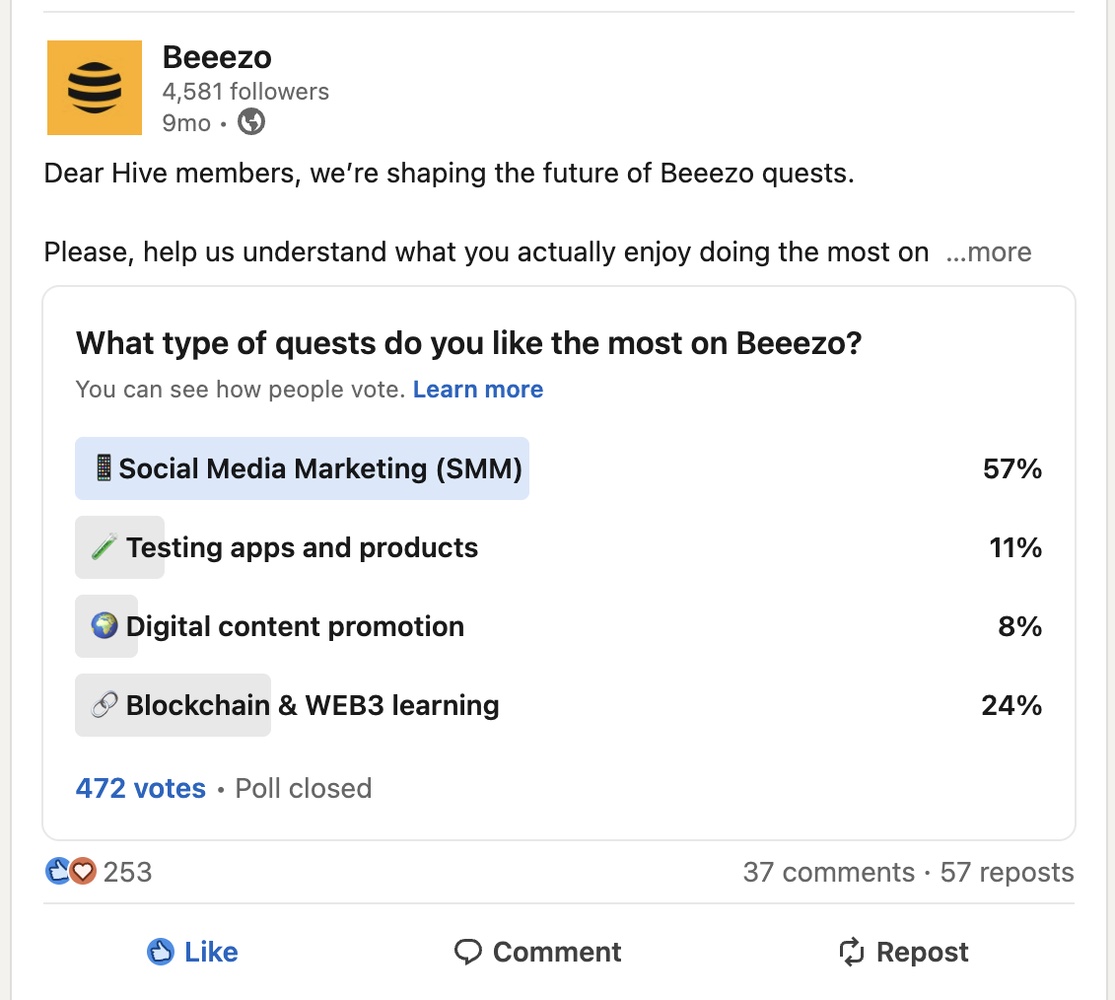
Turn something you've already created into an opportunity for discovery
Let's consider a practical example.
Imagine your company has just launched a new product feature. Your team has prepared an announcement explaining what the feature does, why it matters, and how customers can benefit from it. You publish the announcement on your social page. Now you want more people to discover it.
With Beeezo Social Engagement, that existing content can become the starting point of a campaign.
The experience follows a simple path:
Discover a quest on Beeezo → Visit the brand's social content → Complete the specified activity → Receive a reward after verification.
Your existing announcement now has an additional route to an audience.
Participants know what is expected of them, and your business can evaluate completion of the activity it selected.
Some participants may become curious enough to explore your company further. Others may simply complete the activity and move on. Both possibilities need to be understood when evaluating the campaign.
Verified participation is a measurable result. Genuine interest, customer acquisition, and long-term engagement are separate outcomes that require additional measurement.
This approach works best when the content itself offers something useful and when incentives and activities comply with the relevant social platform policies.
Make discovery part of your growth strategy
Businesses invest considerable resources in creating products, developing websites, building social profiles, and producing content. But how much attention goes into making sure those investments actually reach people?
That is a question worth asking.
A strong social presence can help establish credibility, explain your value, and keep your business connected with its audience. But a social presence alone does not guarantee discovery.
Businesses need to think about both sides of the equation: what people will find when they encounter the brand, and how those encounters happen in the first place.
Beeezo Social Engagement is designed to help with that second challenge by connecting businesses and their content with identity-verified participants through transparent, measurable activities.
You have already invested in building something worth knowing about.
Now give more people an opportunity to discover it.
Have a social page, a product announcement, or content you want more people to explore?
Talk to the Beeezo team about your first Social Engagement campaign.