
Global advertising spend has surpassed $1 trillion. Digital channels dominate allocation. Performance remains the default growth model.
But scale is exposing a constraint.
Not traffic volume. Not targeting precision.
Participation quality.
Juniper Research estimated $84B in ad fraud losses in 2023, with projections approaching ~$170B by 2028. Even under conservative assumptions, mid-decade annual exposure to invalid or synthetic participation has moved into nine-figure territory.
At the same time:
- Automated traffic represents a material share of web activity
- Generative AI has reduced the cost of synthetic engagement toward zero
- Engagement signals can be simulated convincingly
The issue is no longer fraud detection alone.
It is structural access to authenticated, motivated human participation in an automated environment.
The Inflation of Engagement
Performance marketing was built on measurable exposure:
Clicks Impressions Installs Engagement rates
This model functioned when participation was predominantly human and manipulation required cost.
That assumption is weakening.
Bots scale cheaply. AI simulates interaction convincingly. Engagement can be generated without intent.
Optimization now risks amplifying distortion:
- Lower CPC may reflect lower-quality traffic
- Higher engagement may reflect automation
- More installs may not convert into retention
The gap between dashboard metrics and business outcomes is widening.
When synthetic participation scales faster than real participation, performance becomes inflationary.
Scale Changes the Risk Profile
Fraud is not new.
Scale is what changes the equation.
When digital advertising exceeds $750B annually and invalid or low-quality participation reaches material levels, this is no longer marginal inefficiency.
It becomes capital allocation risk.
Filtering traffic after exposure is reactive.
Accessing authenticated participation before allocation is structural.
Traffic alone is no longer a durable performance unit.
Incentives, Latency, and Behavior
Another shift is underway.
Financial infrastructure has become programmable. Settlement cycles that once required days can now execute in minutes.
Latency is not operational trivia.
It shapes behavior.
Opaque payout chains weaken accountability. Slow feedback loops weaken trust. Transparent, immediate incentives reinforce participation quality.
In a compressed digital economy:
- Synthetic signals are scaling
- Incentive cycles are accelerating
- Trust becomes measurable
Performance models must evolve accordingly.
Execution Under Competitive Conditions
Theory matters. Market conditions decide.
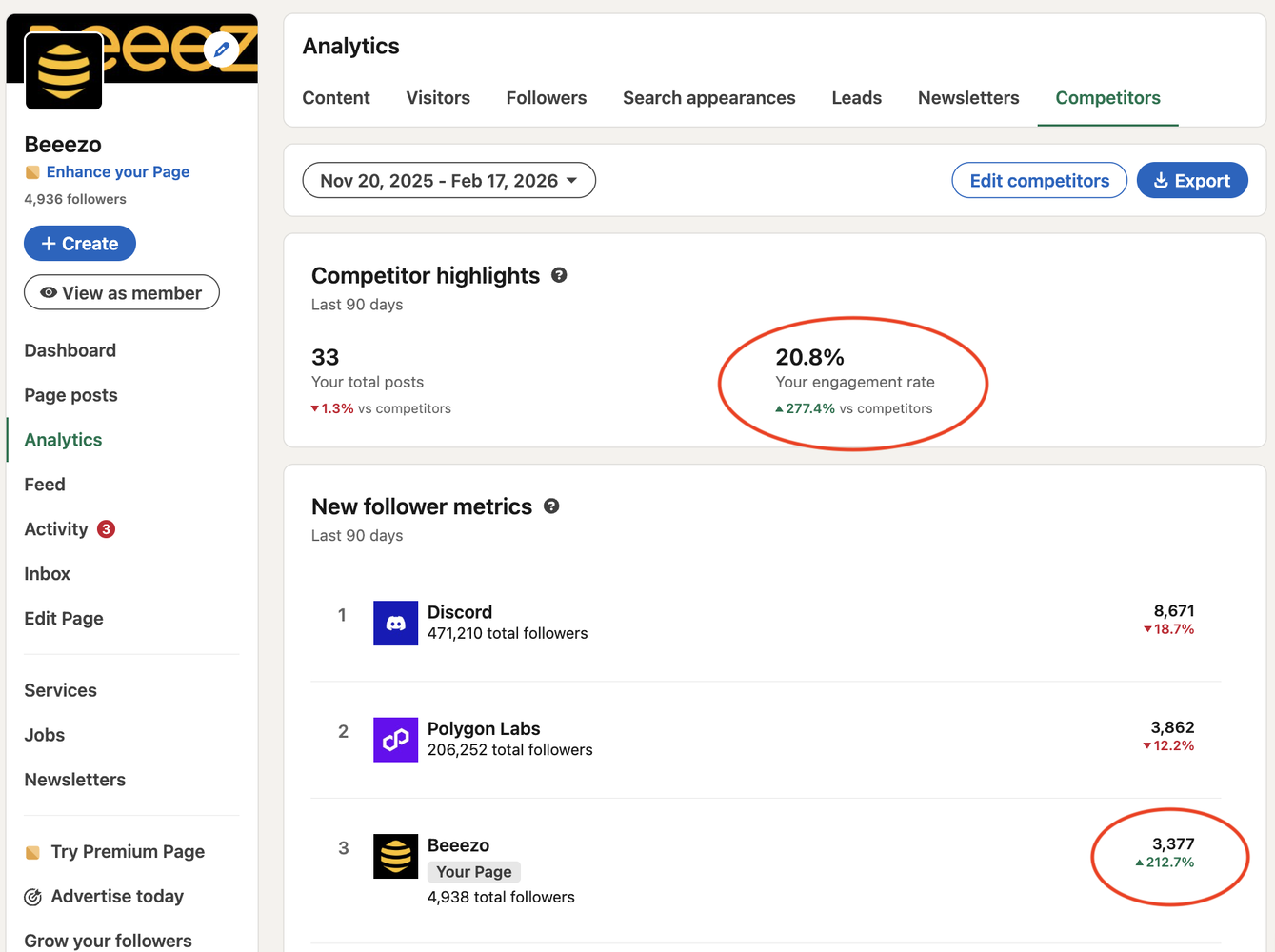
Over the past 90 days, Beeezo deployed a verified participation model inside a competitive Web3 and fintech LinkedIn landscape — alongside established brands including Uniswap Labs, Polygon Labs, Nexo, Paxos, and others.
Instead of optimizing for impressions, the model prioritized:
- Identity-filtered participation
- Task-defined engagement
- Completion-bound incentives
- Transparent feedback loops
The outcome under identical platform conditions:
• 12,525 verified engagement actions
• +370% engagement growth
• 20.8% engagement rate
• +277% vs category competitors
During the same period, several larger pages with significantly higher follower counts experienced flat or declining engagement.
This is not a content anomaly. It is incentive architecture at work.
When participation is identity-filtered, when action requires completion, when incentives settle transparently - engagement reflects execution density, not exposure volume.
Authenticated engagement compounds. Synthetic engagement inflates and dilutes.
In saturated attention markets, reliable human execution becomes measurable economic advantage.

The New Performance Baseline
The next evolution in performance marketing is not better targeting.
It is access to motivated, identity-anchored audiences.
A resilient performance model now requires:
- Identity anchoring
- Verified completion
- Outcome-bound incentives
- Transparent settlement
Traffic becomes discovery.
Verified action becomes economic confirmation.
In an automated environment, authenticated human participation becomes premium inventory.
Premium inventory reshapes budget logic.
For a product launch, 500 verified task-based purchases with documented execution can outperform 50,000 passive impressions.
Execution compounds.
Exposure does not.
From Reach to Execution
For the past decade:
Platforms optimized exposure. Agencies optimized cost curves. Brands optimized scale.
But reach is not execution.
A verified action model operates differently:
Participation is identity-filtered. Incentives depend on completion. Budgets flow directly to verified actors. Settlement reinforces behavior quality.
Instead of buying probability, brands access execution capacity.
Instead of inflating metrics, they build traction.
The shift is subtle, but economically decisive.
What This Means for Growth Leaders
Authentication must precede optimization.
Motivated audiences outperform inflated reach.
Incentive architecture is not an operational detail. It is a competitive lever.
As AI industrializes synthetic engagement, access to verified human execution becomes scarce.
Scarcity creates leverage.
Where Beeezo Fits
Beeezo operates as an execution infrastructure layer for verified human action.
The model integrates:
- Identity filtering
- Task-based engagement mechanics
- Transparent budget distribution
- Fast incentive settlement
It is not designed to inflate traffic.
It is designed to provide brands with access to motivated participants capable of executing defined actions.
Participation must be human. Action must be verifiable. Reward must reinforce completion. Settlement must strengthen trust.
When these elements align, performance becomes economically grounded rather than probabilistic.
Access Over Exposure
Performance marketing was built on optimizing exposure.
Its next phase will be built on authenticating participation.
In a trillion-dollar market facing automation at scale, competitive advantage will not belong to those who generate the most traffic.
It will belong to those who access the most reliable human execution.
Traffic will remain part of growth.
But exposure without identity, verification, and aligned incentives increasingly resembles scale without substance.
Optimization without authentication will not scale in an automated environment.
The structural shift is already underway.
The question is not whether it will happen.
The question is who adapts first.